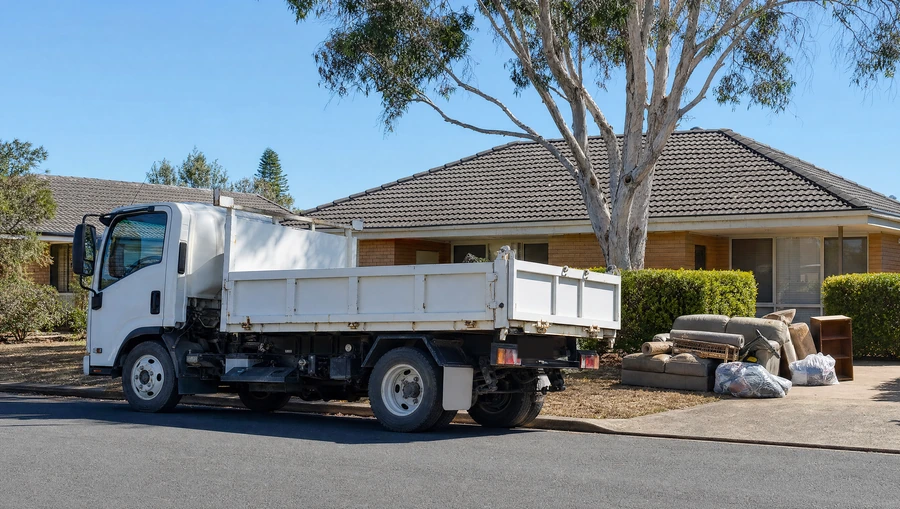
There is a pile in the garage that has been growing for two years, and two ways to make it go away. You can put it on the kerb and wait for the council, or you can put a bin on the driveway and fill it this weekend. Both work. They are not interchangeable, and picking the wrong one is how people end up with half a pile still sitting there in three weeks.
Here is the difference, without the sales pitch: one of them is free at the point of use and runs on somebody else's timetable, and one of them costs money and runs on yours.
What each one actually is
A council household clean-up is a kerbside collection. You stack the load neatly on the verge outside your house, within whatever limits your council sets, and a truck comes past on a day the council decides. Most NSW councils include some form of it in the domestic waste charge you already pay, although how many collections you get a year, whether you have to book one, and how much they will take in a go are all set by the individual council.
A skip bin is a container dropped where you want it and left with you. You load it over the hire period, then it goes when you say it goes. You are paying for the bin, the two truck movements and the disposal of whatever is inside it.
When the council collection is the right call
It usually is, if the job fits inside it. Free is a strong argument, and for a normal household clear-out with no deadline attached, waiting a few weeks costs nothing but patience. Use the council if:
- The load is ordinary household bulk — old furniture, a mattress, a broken appliance, a few bags of general junk.
- It will fit inside whatever your council allows in one collection, and you have one available to use.
- There is nowhere on your property to put a bin, and no rush.
- You can live with the pile sitting on the verge until the truck comes.
Start on your council's own waste page. Across the towns we cover that means Maitland, Port Stephens, Cessnock, Lake Macquarie, Singleton, Muswellbrook or the City of Newcastle, and each one publishes its own rules. We keep a list of who to ask on the council permit guide, which is the other page where the answer depends on which side of an LGA boundary you live.
When a skip is the one to use
The moment the job stops looking like a pile of household furniture, the council option starts running out of road. A skip earns its cost when:
- There is a deadline. Settlement, an end-of-lease inspection, tradies starting Monday, or a family who have to be out of a house by a date. A collection you cannot schedule is not much use against a date you cannot move.
- It is renovation or building waste. Kerbside services are for household items, not for the plasterboard, timber and floor coverings that come out of a bathroom strip. That is trade waste, and it is a different job.
- It is heavy. Soil, brick, tile and broken concrete are not kerbside material anywhere. They go in a smaller bin loaded to its weight limit.
- It is a whole house. A move, a tenancy ending or a deceased estate produces more in a weekend than a kerbside collection is designed to take.
- You would rather not stage it on the verge. A bin on the driveway is contained, it is on your own land, and it does not sit out the front of the house for a fortnight collecting other people's rubbish.
What tends to get left behind
The frustrating outcome is the one where the truck comes and half the pile is still there. It happens because kerbside services have exclusions, and they are not always the ones people expect. Common ones across NSW councils include building and renovation waste, soil and rubble, car parts and tyres, and anything hazardous.
Hazardous material is worth separating in your head from the start, because it is the one category that is nobody's kerbside problem and does not go in a skip either. Asbestos, paint, chemicals, gas bottles and liquids all need their own disposal route — the list on what can go in a skip covers what we cannot take and why.
Using both is allowed
Nobody says you have to choose. A sensible split on a big clear-out is to put the household furniture out for the council collection you are entitled to, and hire a bin for the part they will not take — the renovation waste, the rubble, the green waste, the volume. You pay for a smaller bin than you otherwise would have, and the free service does the work it is good at.
If the reason you are looking at the council option is that there is nobody to shift it all, that is a third answer: rubbish removal is a crew who load it for you rather than a bin you fill yourself.
Working it out in about a minute
Three questions, in this order.
- Is there a date? If there is, hire a bin. Everything else is detail.
- Is it all household items? If it is, check your council's page. If there is building waste, soil or green waste in it, that part is going in a bin regardless.
- Where would the bin go? If you have a driveway, this is easy and there is no permit involved. If the only spot is the road or the verge, that is council land and it changes the job — see council permits.
Still not sure which way to go? Tell us what you are looking at and we will say so honestly, including when the answer is to wait for your council. Have a look at the size guide if you want to picture the volume first, or the areas we cover to check we come to you.