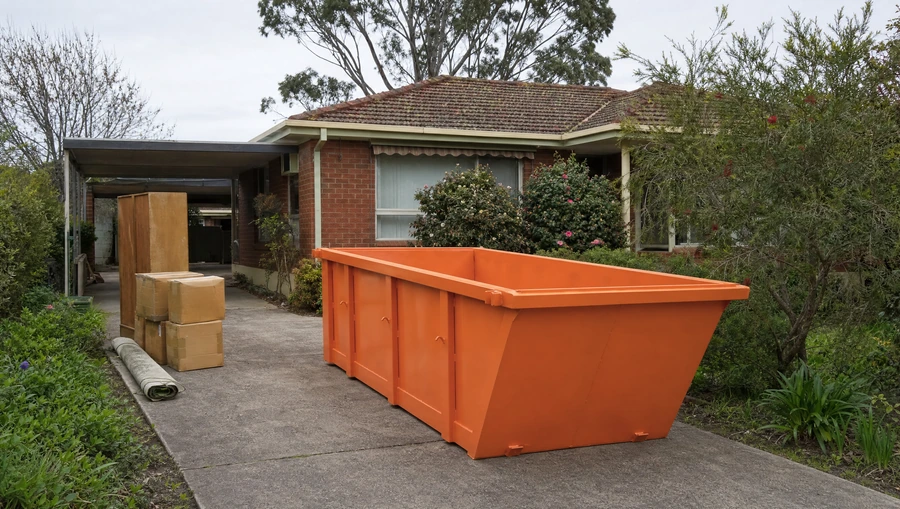
Almost nobody runs out of room in a skip because they had too much rubbish. They run out of room because they had too much air. A wardrobe thrown in whole, a couch dropped on the diagonal and four boxes still assembled will take a third of a bin between them and hold nothing.
Packing a skip is not complicated, but it does have an order, and the order matters more than the effort. Here is how to get a whole job into the bin you booked.
Two things are being filled at once
Every bin has a volume and a weight allowance, and you are consuming both as you load. Light bulky material — furniture, packaging, plastics, garden prunings — runs the volume out first. Heavy material — soil, brick, tile, concrete — runs the weight out while the bin still looks half empty.
Which one you hit first decides how you should be loading. If it is a household clear-out, you are playing a space game and everything below applies. If there is rubble in it, read the weight limits guide first, because no amount of clever stacking helps once the load is too heavy to lift.
Sort before you load, not while you load
Ten minutes of sorting on the lawn saves an hour of re-stacking. Before anything goes in, split the pile into four:
- Flat and rigid — doors, bench tops, sheet material, pallets, bed bases. This is your floor and your layers.
- Bulky and awkward — lounges, wardrobes, mattresses, appliances. This is what has to be broken down or placed deliberately.
- Loose and small — bags, offcuts, packaging, garden waste. This is the filler that goes into the gaps.
- Not going in at all — anything on the prohibited list, and anything worth selling or donating. Both are easier to pull out now than later.
Load flat first, then big, then fill
The order is the whole technique. Work in layers, from the back of the bin towards the door end.
- Flat items on the floor. Lay doors, sheeting and bench tops flat across the base. They cost you almost no height and they give you a level surface to build on.
- Big rigid items next, sides down. A wardrobe carcass laid on its back is a shelf. Stood upright it is a chimney of empty space.
- Fill every gap as you go. Bags of soft rubbish, offcuts and packaging belong in the voids beside and under the bulky items, not in a pile on top of them at the end.
- Keep the load flat as it rises. A mound in the middle wastes the corners and has to come off before the bin can be moved.
- Heavy and dense material low. It travels better and it keeps you off a stack that is going to shift when you put the last thing on it.
Break things down — it is the single biggest win
This is where the volume actually comes from. Flat-packed furniture goes back to flat panels with a screwdriver. Cardboard boxes cut down to nothing. Timber cut to the length of the bin stacks instead of bridging. Garden prunings cut short lie down instead of springing back.
A lounge is the classic example. Whole, it can take a quarter of a small bin on its own. Cut into its frame, cushions and cover, the same lounge fills gaps other things left behind. If you only do one thing off this list, do this one.
Why the load has to sit level with the rim
The bin has to be lifted onto a truck and driven on a public road, so nothing can sit above the top of the sides. It is not a preference and it is not us being difficult — an overloaded bin cannot be legally or safely transported, and anything sticking up has to come off before it moves.
Practically, that means: stop building at the rim, not above it. If it is green waste or anything springy, it wants pressing down as you go rather than levelling at the end. And if you are close, tell us when you call rather than hoping — it is easier to sort out before the truck is on your street.
The mistakes that cost people a second bin
- Starting with the biggest item. The couch goes in first, lands on an angle, and everything after it is built around a hole.
- Leaving the boxes assembled. Cardboard is mostly air until you flatten it.
- Filling from the door end. Work from the far end so you keep access for as long as possible.
- Mixing rubble through a general load. A few buckets of broken concrete through a household bin can put it over weight. Heavy material belongs in a heavy waste bin of its own.
- Booking on the pile, not the volume. A pile on the lawn looks bigger than it is. The size guide gives each bin in wheelie bin equivalents, which is a much easier thing to picture.
When in doubt, ask before you book
If you tell us what is in the pile — rough volume, what it is made of, whether there is soil or rubble in it — we will tell you which bin actually fits it. That conversation takes two minutes and it is a lot cheaper than a second delivery. Have a look at how skip hire works, or send the job through and we will size it for you.